How to Set Up a Dart Board Correctly
This website is reader-supported. We may earn a small fee from qualifying purchases through product links.Setting up a dart board at home is a fantastic idea for those who have the space to do so.
Dartboards aren’t as expensive as you might think. Even the best dartboards only cost around $50.
That’s a very small investment for something that brings so many hours of enjoyment, and it’s all you need to get started with learning how to play darts and practicing at home.
So let’s get started.
What You Need to Set Up a Dart Board
To set up a dart board at home, you’ll need:
- A good dart board
- A wall that is at least 6 feet 8 inches high and away from any windows
- A minimum of 9 feet of space back from the wall to throw
- A drill to create a screw hole
- A screw if attaching to a wall stud, or a wall-anchor otherwise
Hanging the Dart Board
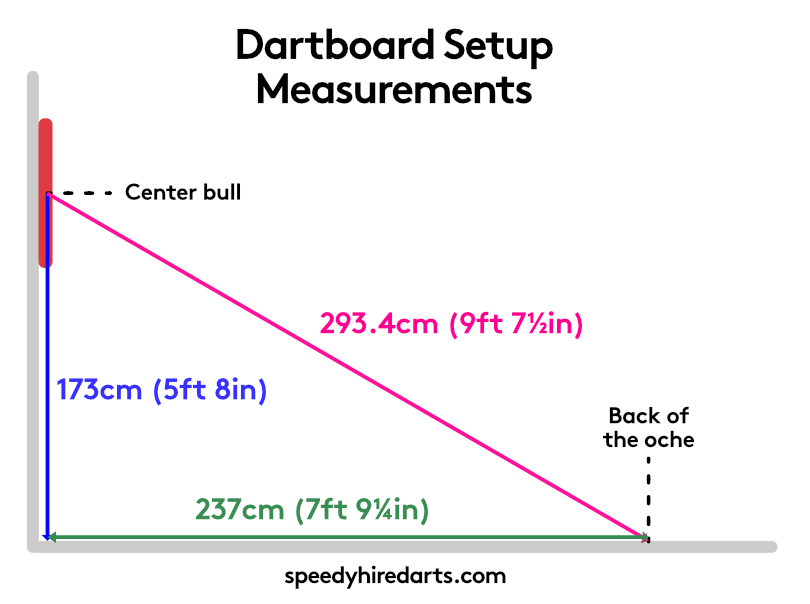
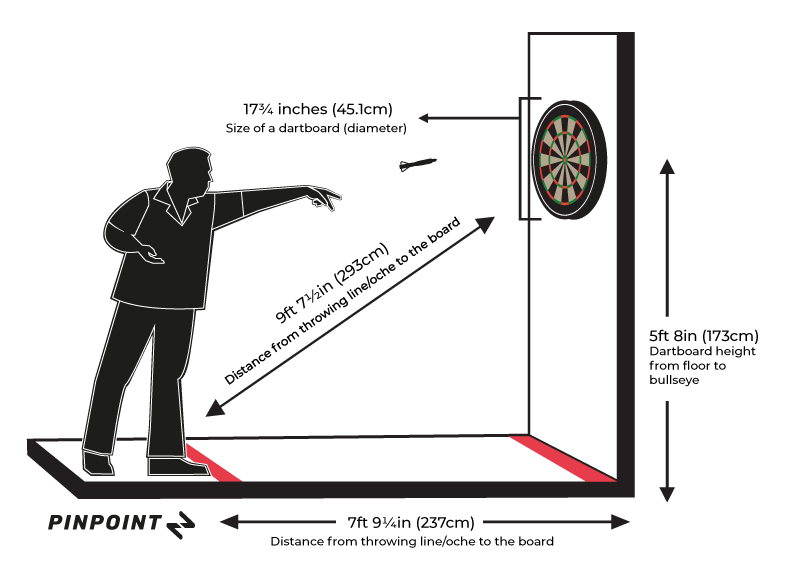
You should hang a dart board so that the center of the inner bullseye is 5 feet 8 inches from the floor.

Before you go measuring up and drilling a hole right there, check the back of your dart board for the location of the mounting bracket.
Not all dartboards have their mounting brackets dead center where you’d expect. This is especially true of electronic dart boards.
If your dart board has a mounting bracket that is 2 inches above the center of the board, then you’ll need to measure 5 feet 10 inches from the floor before drilling.
Attaching the dart board to a wall stud is the best option since it will ensure the dartboard is sturdy. Wall studs are solid pieces of wood inside the wall. If you can’t hang the dart board on a wall stud, then be sure to use an appropriate wall anchor to support the dart board’s weight.
Once you’ve drilled your hole in a position that will allow the dartboard to hang with the bullseye 5 feet 8 inches from the floor, then screw in a screw to hang the dart board on.
Top tip: You should make sure the screw is as far in as it can go while still allowing the dart board mount to slot in between the screw and the wall. Dart boards should be hung flush to the wall, not hanging forwards at an angle.
Hang the dartboard on your screw with the 20 segment at the very top. Measure to double-check that the bullseye is 5 feet 8 inches from the floor.
Measure a Throwing Line
A lot of people make a mistake when measuring their throwing line (or oche).
They make this mistake because they read online that the throwing distance is 7 feet 9¼ inches. They then measure from the wall back 7 feet 9¼ inches and think yep, that’s great.
This is wrong:
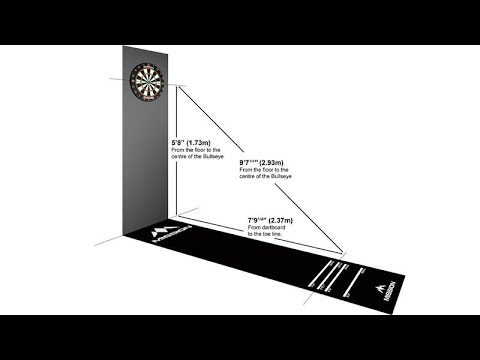
Notice how the distance when measuring from the wall doesn’t meet where the back of the oche should be?
This is because the distance a throwing line should be is 7 feet 9¼ inches but from the dart board, not the wall.
Dart boards are an inch or two thick, and an inch or two makes a lot of difference when you need to be accurate within a few centimeters.
To avoid making this mistake, and providing you have even floors (you really should!), then it’s best to measure diagonally from the bullseye to the floor.
Place a measuring tape on the bullseye, measure 9 feet 7 inches½ back, then lower until the other end of the measuring tape touches the floor. That’s your throwing line.
As this diagram shows, you now have a correct throwing distance of 7 feet 9¼ inches from the dartboard:
Dart Board Height
The regulation dart board height is 5 feet 8 inches (1.73 m) from the floor to the center of the bullseye. It is the same for steel-tip and soft-tip boards, for men and women, and for every governing body that publishes rules. Measure to the bull, not to the top or bottom edge of the board, and measure from the finished floor, not from a mat or a raised oche.
Dart Board Distance (Throw Line)
The throwing distance depends on which kind of darts you play with:
| Board type | Bull height | Throw line from the board face | Diagonal from bull to line |
|---|---|---|---|
| Steel tip (bristle board) | 5 ft 8 in / 1.73 m | 7 ft 9¼ in / 2.37 m | 9 ft 7½ in / 2.93 m |
| Soft tip (electronic board) | 5 ft 8 in / 1.73 m | 8 ft / 2.44 m | 9 ft 9¾ in / 2.99 m |
The distance is measured from the face of the board to the back edge of the throw line, horizontally along the floor. If your floor is level, the diagonal measurement in the last column gets you to the same place without needing to account for the thickness of the board or the cabinet it hangs in.
Many home players simply use 8 feet for both types of darts. That is fine for a game in the garage. If you play in a league, practise at the distance your league uses, because two and three-quarter inches is enough to change where your darts land.
Dart Board Setup Questions
How far should the board be from side walls?
Give yourself at least 2 to 3 feet either side of the board so a stray dart hits a surround or a plain wall rather than a door frame or a light switch. A dart board surround is cheap insurance.
Do I need to measure from the wall or from the board?
From the face of the board. A bristle board is about an inch and a half thick and a cabinet adds more, so measuring from the wall makes the throw line too far away. The diagonal method above avoids the question.
What if the ceiling is low?
The bull height is fixed, so a low ceiling only matters if the top of the board (about 6 feet 5 inches for a standard board) would touch it. Anything above 7 feet is fine.
Should the oche be raised?
Not required. A tape line on the floor is enough for home play. A raised oche just makes it easier to feel where your toes are without looking down. If you use one, measure to its back edge, the side nearest you.
Which number goes at the top?
The 20, with the 3 directly below at the bottom. Turn the number ring every few weeks so the 20 segment does not wear out before the rest of the board; most boards have a removable number ring for exactly that reason.
Once the board is up, the next step is learning to hit it: see how to throw darts, and pick a game from the darts games list.
Congratulations, you’re done!
There you have it, you’ve successfully set up your first dart board, and have hours of fun ahead of you.
Here’s a diagram showing all of the dart board measurements together for reference: